Context
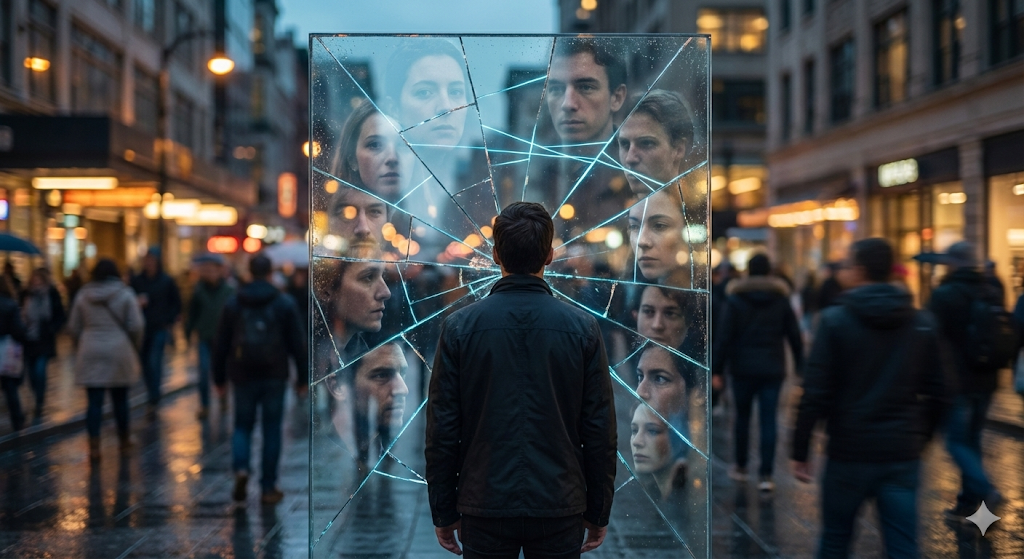
Our intuition is linear. We walk into a room of 23 people and feel unique. The data says we are likely not.
This is the fundamental tension between how we perceive the world and how the world actually works. We are biological creatures, evolved to recognize patterns in small groups, to feel special in our uniqueness. But mathematics doesn’t care about our feelings. It reveals truths that our intuition cannot grasp.
The Birthday Paradox is one of those truths—a gentle reminder that our brains are not calculators, and that sometimes, the most counterintuitive results are the most profound.
The Challenge
Before we dive into the mathematics, let me ask you: What do you think is the probability that two people in a room of 23 share the same birthday?
Take a moment. Think about it. Most people guess somewhere between 5% and 10%. After all, there are 365 days in a year, and only 23 people. The odds seem slim.
But here’s where intuition fails us.
Try it yourself
Try running the simulation a few times. Watch as matches appear more often than you’d expect. Then switch to the Math tab and see the probability curve—notice where it crosses 50%.
The Explanation
Why does this happen? It’s not about your birthday matching someone specific. It’s about any two people matching each other.
Think of it like the Handshake Problem: In a room of 23 people, how many unique pairs can be formed? The answer is 23 × 22 / 2 = 253 pairs. That’s 253 opportunities for a match, not just 22 (the number of other people you could match with).
The mathematics works like this: We calculate the probability that all birthdays are unique, then subtract from 1. For each person added to the room, the probability of maintaining uniqueness decreases multiplicatively:
- Person 1: 365/365 (guaranteed unique)
- Person 2: 364/365 (one day already taken)
- Person 3: 363/365 (two days taken)
- …
- Person 23: 343/365 (22 days taken)
When we multiply these probabilities together, we get the probability that all 23 birthdays are unique. Subtract from 1, and we find the probability of at least one match: approximately 50.7%.
The key insight: We’re not comparing one person to 22 others. We’re comparing 253 pairs simultaneously.
The Handshake Analogy
Imagine you’re at a networking event with 23 people. You might think: “I only need to shake hands with 22 people.” But the total number of handshakes in the room is 253. Each handshake is an opportunity for connection—or in our case, a birthday match.
This is why the probability is so much higher than intuition suggests. We’re not looking for one specific match; we’re looking for any match among all possible pairs.
Conclusion
The Birthday Paradox teaches us something deeper than probability theory. It reveals a fundamental truth about data science: We must unlearn our biological intuitions to see the truth.
Our brains evolved to recognize patterns in small groups, to feel special in our uniqueness, to see coincidences as meaningful. But data doesn’t care about our feelings. It reveals patterns that exist whether we notice them or not.
The next time you walk into a room and feel unique, remember: the data might say otherwise. And that’s not a failure of your intuition—it’s a reminder that truth often lies beyond what feels right.
We are not alone in our solitude. We are connected by mathematics, by probability, by the invisible threads that bind us together in ways our intuition cannot grasp.
That’s not magic. That’s math.